


- Pipeline Notice: Undefined offset: 2 in /home/host/scai/www/html/_skin/layout/inc_navigation_middle.php on line 61 Notice: Undefined offset: 2 in /home/host/scai/www/html/_skin/layout/inc_navigation_middle.php on line 88 Notice: Undefined offset: 3 in /home/host/scai/www/html/_skin/layout/inc_navigation_middle.php on line 88
Pipeline.
SCAI-005 (Axitinib) :
SCAI-005: A Breakthrough Topical Therapy for Wet AMD
Wet age-related macular degeneration (wet AMD) is a progressive retinal disease caused by abnormal blood vessel growth in the macula, often leading to vision loss and, in severe cases, blindness.
Currently, the standard of care involves intravitreal injections of VEGF inhibitors such as aflibercept. While effective, these treatments require frequent administration, placing a significant burden on patients and caregivers.
Tyrosine kinase inhibitors (TKIs) like axitinib, which block the VEGF receptor, are expected to provide similar therapeutic benefits.
SCAI-005 is a groundbreaking axitinib eye drop developed using proprietary MOASIS technology, enabling non-invasive delivery of VEGFR TKI directly to the retina via topical administration.
In rabbit pharmacokinetic studies, SCAI-005 demonstrated high penetration into posterior ocular tissues with minimal systemic exposure.
In monkey CNV model studies, it significantly reduced both the number and area of CNV lesions, as well as retinal thickness—while maintaining an excellent safety profile, with no observed ocular or systemic side effects.
The Phase 1 clinical development was completed in November 2025, and SCAI-005 was found to be safe and well-tolerated with no ocular irritation or systemic adverse effects. We are preparing to initiate a Phase 2 clinical trial in patients with wet AMD in 2026.
SCAI-005 represents a safe, effective, and patient-friendly alternative to conventional injection-based therapies for wet AMD.
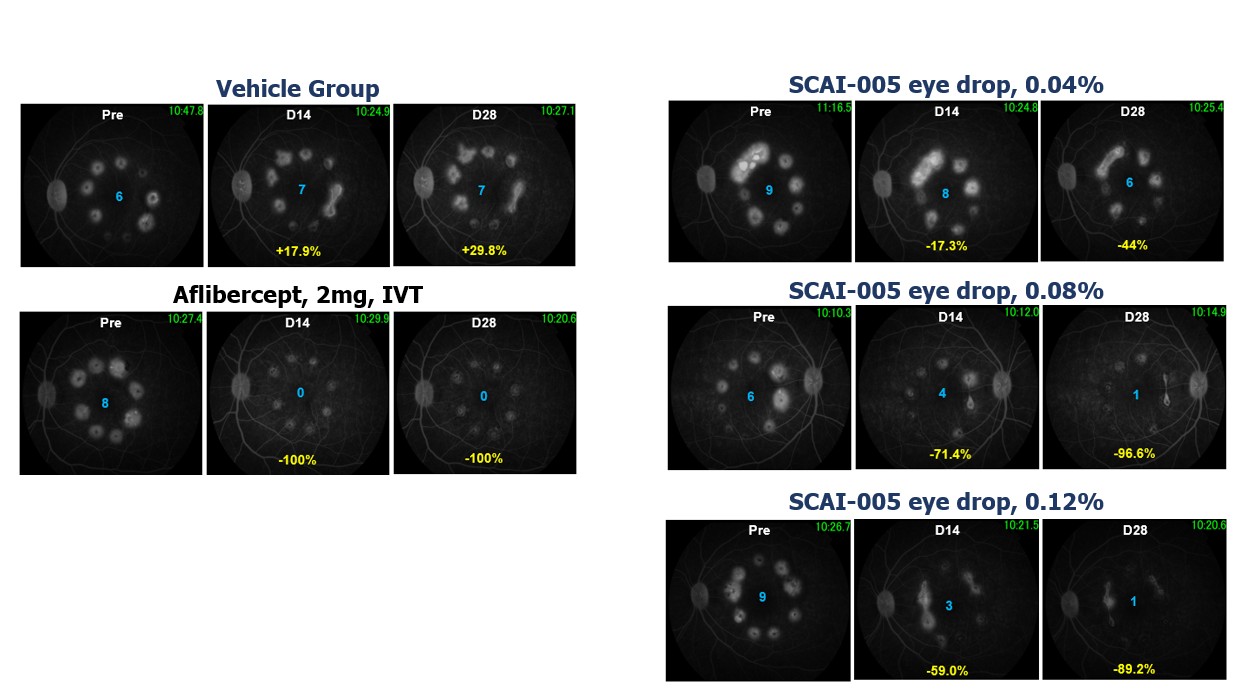
Fig. Representative FFA (Fundus Fluorescein Angiography) images from the Monkey CNV model
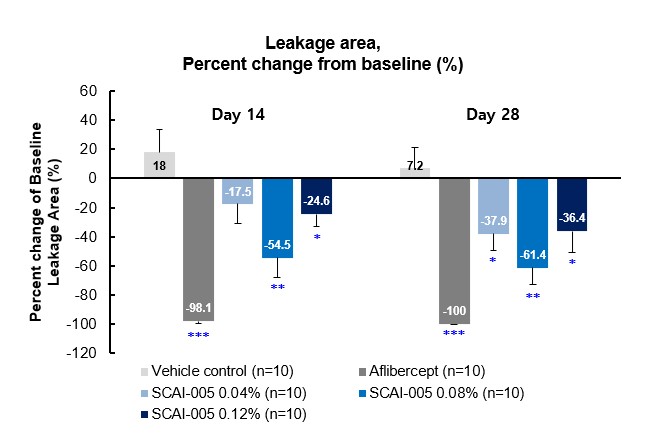
Fig. Percent change of leakage area from the Monkey CNV model